
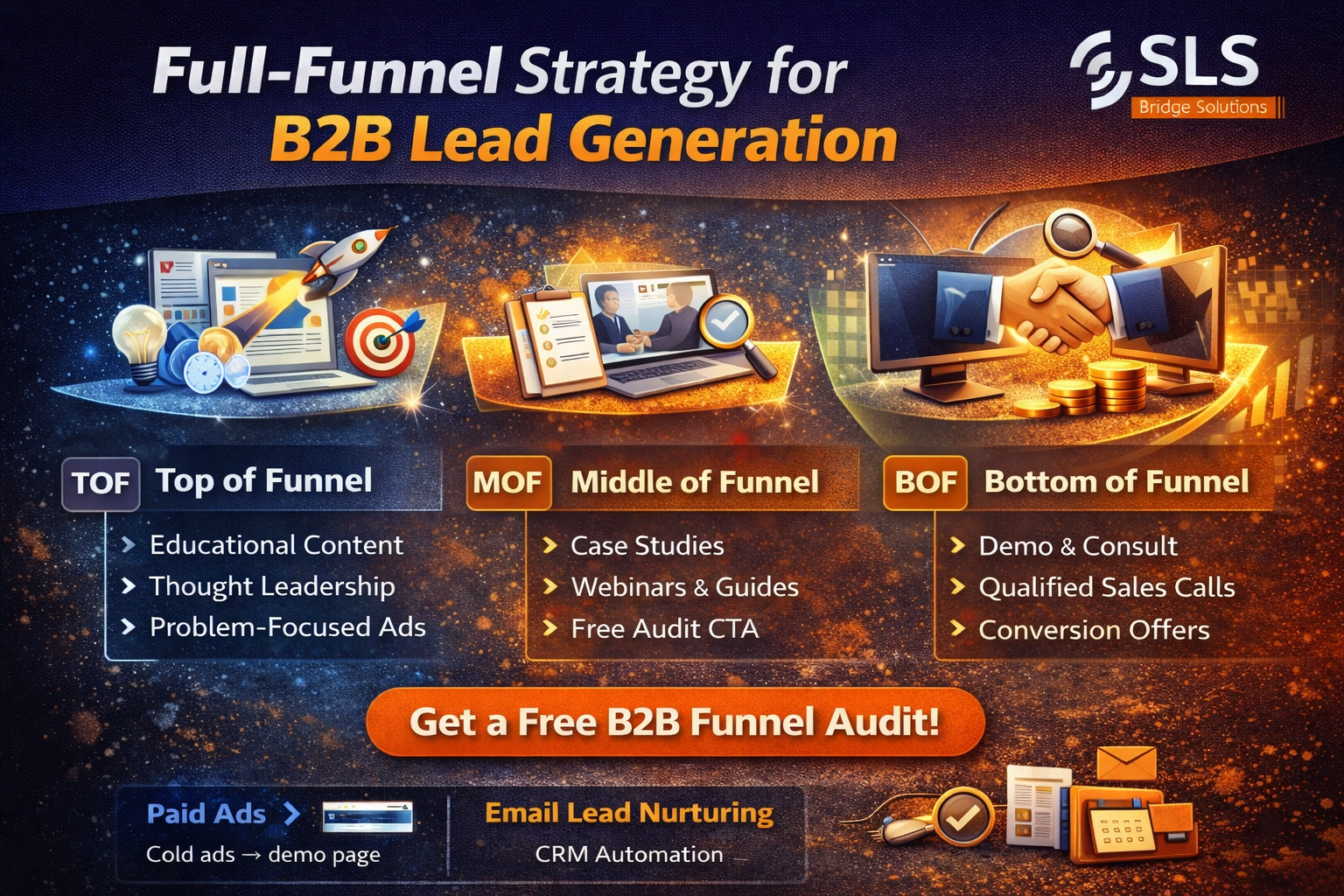
Introduction: Why B2B Lead Generation Needs a Full-Funnel Approach
B2B lead generation has changed dramatically. Buyers are more informed, sales cycles are longer, and multiple stakeholders influence purchasing decisions. In this environment, running isolated campaigns or relying on a single channel is no longer effective.
A full-funnel strategy for B2B lead generation ensures that every marketing effort—paid ads, content, landing pages, and nurturing—works together to guide prospects from first interaction to qualified sales conversations.
Instead of chasing volume, a full-funnel approach focuses on lead quality, intent, and predictable pipeline growth.
Why Traditional Lead Generation Fails in B2B
Many B2B companies struggle with:
- Low-quality leads
- High cost per lead (CPL)
- Inconsistent or unpredictable pipeline
The root cause is almost always a fragmented strategy. Common issues include:
- Ads focused only on lead forms
- No segmentation between cold, warm, and hot audiences
- Sales teams receiving unqualified or low-intent leads
- No nurturing between first click and sales outreach
Without a structured funnel, prospects either drop off early or reach sales without enough context, trust, or intent.
What Is a Full-Funnel Strategy?
A full-funnel strategy aligns marketing activities with the buyer’s journey. Instead of pushing every prospect toward the same conversion, it meets them where they are and moves them forward step by step.
A complete funnel includes:
- Top of Funnel (TOF): Awareness and education
- Middle of Funnel (MOF): Trust building and evaluation
- Bottom of Funnel (BOF): Conversion and qualification
Each stage has a distinct goal, message, and success metric—ensuring leads are nurtured effectively before reaching sales.
Top of Funnel (TOF): Creating Qualified Awareness
At the top of the funnel, the goal is not immediate conversion. The focus is on capturing attention and establishing relevance.
This is where B2B brands help prospects understand:
- The problems they are facing
- Why those problems matter
- What happens if they are not solved
Effective TOF strategies include:
- Educational blogs and thought leadership content
- Problem-focused paid ads and explainer videos
- Industry insights, trends, and frameworks
👉 Example TOF content can be hosted within your learning ecosystem at
https://academy.slsbridge.com/
Key Metrics: Engagement, reach, and click-through rate — not leads.
Middle of Funnel (MOF): Turning Interest into Intent
The middle of the funnel determines lead quality. At this stage, prospects understand the problem and are actively evaluating solutions.
Your goal here is to:
- Build trust and authority
- Demonstrate expertise
- Reduce risk and uncertainty
Effective MOF assets include:
- Case studies and real-world use cases
- Webinars, audits, and in-depth guides
- Comparison frameworks and strategic insights
Primary MOF CTA:
👉 Book a Free Audit — after delivering clear value.
This is where prospects move from interest to intent.
Bottom of Funnel (BOF): Converting with Confidence
At the bottom of the funnel, prospects are ready to take action. They are comparing vendors, evaluating outcomes, and looking for clarity.
Strong BOF strategies include:
- Conversion-optimized landing pages
- Clear value propositions and outcomes
- Qualification filters aligned with sales
👉 BOF conversion pages should clearly connect to your core offerings, such as:
https://slsbridge.com/our-services/
Expected Outcome:
Fewer leads — but significantly higher quality and close rates.
How a Full-Funnel Strategy Improves Lead Quality
When all funnel stages work together:
- Cold traffic is warmed before conversion
- Sales teams receive better-prepared leads
- Cost per lead decreases over time
- Conversion rates improve across channels
Instead of chasing volume, full-funnel strategies focus on efficiency, intent, and predictability.
The Role of Paid Ads in a Full Funnel
Paid ads are most effective when mapped to funnel stages:
- TOF Ads: Drive awareness and qualified traffic
- MOF Ads: Retarget engaged users and generate leads
- BOF Ads: Convert high-intent prospects
This ensures paid media works as a system, not as isolated campaigns.
Automation and Nurturing: The Missing Link
Even high-quality leads rarely convert immediately. Nurturing ensures no lead is wasted.
Key elements include:
- Email nurturing sequences
- Retargeting campaigns
- CRM tracking and segmentation
Note: While automation plays a critical role in nurturing and sales alignment, this strategy focuses on paid media, social media, and content marketing, not the technical implementation of automation workflows.
Measuring Success in a Full-Funnel Model
A full-funnel strategy tracks performance across all stages:
- TOF: Engagement metrics (clicks, views, reach)
- MOF: Lead quality, intent, and engagement depth
- BOF: Conversion rate, pipeline value, and deal quality
This data-driven approach enables continuous optimization and predictable scaling.
Final Thoughts
B2B lead generation today is not about running ads or collecting contacts. It’s about building a system that educates, nurtures, and converts prospects consistently.
A full-funnel strategy aligns marketing and sales, improves lead quality, reduces CPL, and turns paid traffic into predictable growth.
👉 Get a Free Audit to see how your current funnel can be optimized for higher-quality B2B leads.
