
How We Built a Lead Classification System for a Struggling Service-Based Sales Team
Most business owners spend thousands, sometimes hundreds of thousands, generating leads from multiple channels, only to lose them right after capturing attention.
This silent revenue leakage is common among service-based businesses with a consistent inflow of leads.
After marketing has done its job, the Marketing Qualified Leads (MQLs) enter the sales pipeline but without a structured lead classification system, the sales team treats all opportunities the same, ignoring budget, urgency, or revenue potential.
And that’s where the problem begins: the absence of a lead classification system.
Recently, a service-based business reached out to us, explaining they received 43 inbound leads every 20 days.
On paper, that looks impressive. But in reality, the sales team was exhausted.
The sales team sent the same generic response to every lead, and high-ticket prospects ended up in the same queue as low-budget enquiries.
And to make matters worse, follow-ups were manual, inconsistent, and dependent on memory.
At the end of the day, our client had a pipeline full of activity but the conversions didn’t reflect the opportunity.
After analyzing the situation, one issue became obvious; the client lacked a structured lead classification system to intelligently pinpoint and prioritize serious buyers.
This reveals that without an automated system, service-based businesses risk losing high-ticket sales to faster competitors.
A lead who is ready to spend serious money always has serious questions. However, if your first point of contact doesn’t address their specific needs or budget tier immediately, they won’t wait.
They’ll move on to a provider who is ready for them.
As a service-based business owner, your job doesn’t end at capturing attention; the real work is in retaining it.
Otherwise, every dollar spent on marketing is a dollar wasted. That is simply not the ROI we want for our clients.
Therefore, if you are still manually responding to every enquiry, have no CRM visibility, and operate with an invisible pipeline, chances are you are losing money without even realizing it.
We wrote this blog specifically for you.
What Is a Lead Classification System?
A lead classification system is a unique automated system designed to segment the leads entering a business’s sales pipeline.
Traditionally, there are three kinds of leads a business could get, namely: cold, warm, and hot leads. And we treat each type of lead differently.
Our focus in this blog is on both the warm and hot leads.
Normally, hot leads fall into the Marketing Qualified Leads (MQLs) category. Your marketing efforts pre-qualify these prospects, who show interest by downloading a report or subscribing to your newsletter.
Once MQLs enter your sales pipeline, the sales team takes over.
This is where members of the sales team perform a series of actions to assess the potential and readiness of the MQLs to make a purchase.
In a small service-based business, the sales team will have to manually qualify each lead before determining which ones are fit to be categorized as Sales Qualified Leads.
This process involves recording the lead’s data, handling their enquiry, sending multiple emails, and following up to close the sale.
Thankfully, this process can now be automated via a lead classification system, saving time and allowing sales teams to focus only on qualified leads with real buying potential.
No more wasted effort as conversations only take place with those who are more likely to make a purchase.
How We Helped a Service-Based Client Optimize Their Leads Pipeline With the SLS Lead Classification System
As a growth marketing agency that has worked closely with several B2B businesses in the last five years, we uncovered a significant but often overlooked system leakage in our clients’ lead pipelines.
Most were generating leads, just like the service-based business owner who was generating 43 leads every 20 days.
Unfortunately, the sales team could neither manage nor track the drop-off points because they were overwhelmed and burnt out.
If the inbound leads had been relatively small, manually managing the pipeline would have been less tedious. But in their case, where the leads kept increasing, the system the company had operated for years no longer served them.
And that was where we came in. Because for every problem, there is a solution.
After identifying the key issue, which was the absence of an automated system, we designed an automated lead classification system to fix it. This system was built by experts who combined market-leading automation with deep expertise in solving complex lead qualification challenges.We’ll cover how the lead classification system works in the next section.
How the SLS Bridge Lead Classification System Works
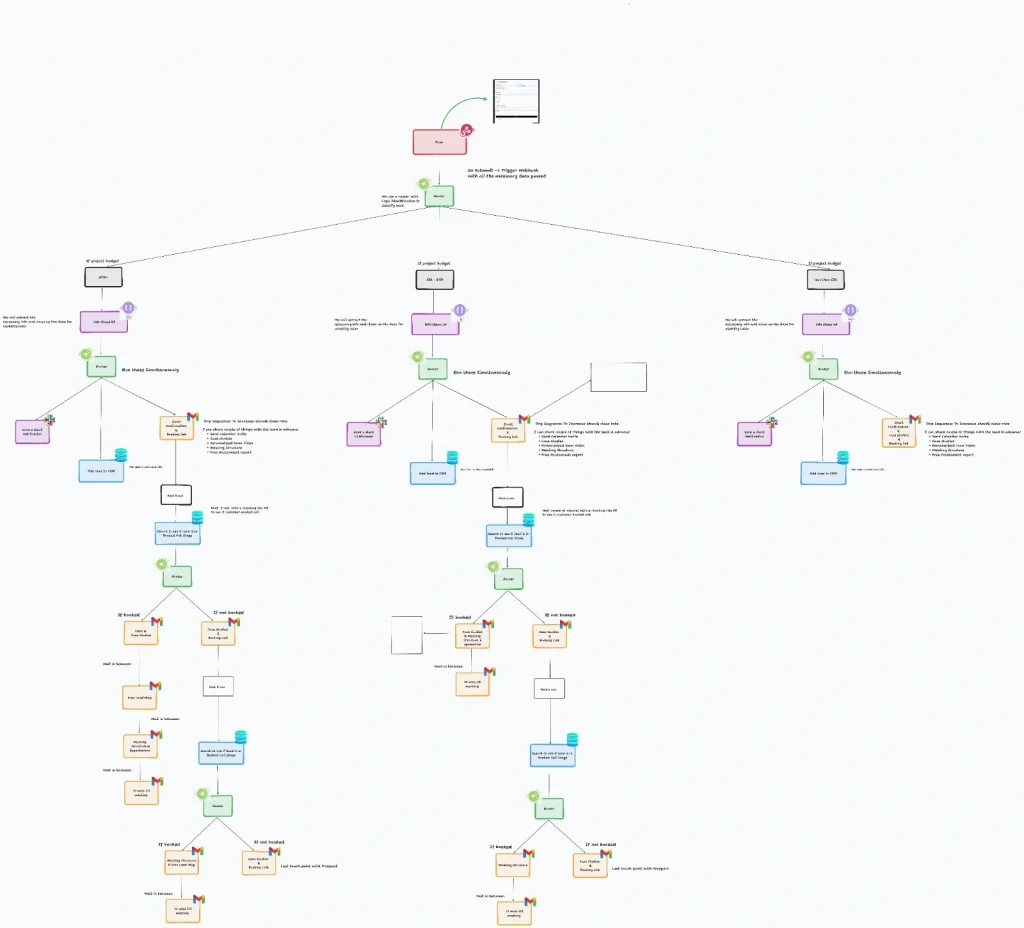
The moment a lead arrives, it is immediately classified by its revenue potential, captured through the company’s website form.
This critical first step determines everything the automation does next.
Just like a missile at launch, the system activates instantly at the heart of our automated lead classification system.
It captures the initial information and then automatically executes every task that once required manual effort.
1. The Lead Classification:
Our lead classification system operates on a three-tier revenue structure that instantly segments leads by revenue potential. The first tier serves leads with less than $5,000 in revenue potential. The second tier serves leads between $5,000 and $15,000. The third tier serves high-ticket leads with over $15,000 in revenue potential.
2. The CRM Entry:
After classification takes place, the system immediately captures the lead’s data in the inbuilt CRM, designated for each category. Think business name, contact details, behavioral data, and more. The system records and organizes every critical piece of information in real time.
3. Team Receives an Internal Notification:
The system classifies each lead and records their details, then notifies the sales team immediately. At this point, no manual interaction is required from the team. They stay informed while focusing on higher-priority revenue conversations.
4. The Outbound Emails:
This is where everything gets interesting. Unlike the regular lead qualification system, where a member of the sales team sends a generic email, our lead classification system handles this automatically and customizes the email based on the information recorded in its database. No two leads are the same. The system understands this and treats them accordingly.
5. The Follow-up Sequence:
Just like the outbound emails, the follow-up sequence is unique to each lead and optimized for better conversion. That way, time is maximized, responses are more accurate, and lead qualification becomes more efficient. Sales teams focus only on high-value conversations with prospects most likely to convert. They hop on calls filled with confidence, knowing they are speaking to the right prospect.
Now let’s talk about high-ticket leads.
High-Ticket Leads in a Service-Based Business
Although all leads are treated with great care, high-ticket leads get a VIP pass.
Service-based businesses often prioritize high-ticket sales because they accelerate progress toward Annual Recurring Revenue (ARR).
It is also more economically efficient compared to working on multiple low-ticket deals.
We understood this and took it into consideration when designing the lead classification system.
Because high-ticket leads are serious buyers. They don’t play.
Hence, our system matches that seriousness with immediate, high-priority attention.
There is no room for doubt since the system sends emails promptly, delivers reminders when necessary, and automates follow-ups.
Every step is engineered to drive one action; booking a call with the sales team.
Our system transformed the client’s sales team, which once struggled with 43 leads every 20 days under a broken lead qualification system, leaving them drained and frustrated.
They now effectively manage their pipeline with an automated lead classification system that qualifies, interacts with, and follows up with each lead until a call is booked.
Pressure has been significantly eliminated because the workflow now runs automatically.
4 Reasons You Should Consider an Automated Lead Classification System
Here are 4 reasons to consider investing in a lead classification system:
1. Prompt Response:
Response time is no longer limited to the company’s working hours. The system never sleeps and responds 24/7, across all time zones. Unlike a fatigued team member, the system responds instantly, every time.
2. Tier-Appropriate:
The system sends each lead a relevant, tier-appropriate response within seconds of their enquiry.
3. Close High-Ticket Leads
High-ticket buyers get instant, consistent attention, increasing every chance of closing big deals
4. Lead Behaviour is Trackable:
The Airtable CRM in the lead classification system lets the sales team view the pipeline in real time. Additionally, the team sees the pipeline at a glance, tracking calls and knowing exactly when to engage.
Traditional Lead Qualification System vs. Automated Lead Classification System
A traditional lead qualification system evaluates a lead’s readiness to make a purchase using frameworks like:
- BANT: Budget, Authority, Need, & Timeline
- CHAMP: Challenges, Authority, Money, & Priorities
- MEDDIC/MEDDPICC: Metrics, Economic Buyer, Decision Criteria, Decision Process, Identify Pain Points, Champion, & Competition
Another approach, lead scoring, assigns a number to each lead based on their engagement and behavior with the business.
But with an automated lead classification system, sales teams can save 50–75% of their weekly time spent on manual account research and see a 30–50% reduction in CRM administration. Truly, this is one of the smartest innovations a modern sales team can use.
Qualify More Leads in Less Time
In business, time is money; and every new client counts.
Every activity your team performs ultimately drives toward one North Star: increasing revenue.
While marketing generates interest, the final results depend on your sales team.
And by that, I mean the lead qualification, hopping on calls with those who are ready, and closing the deal.
Having a working lead classification system accelerates this entire process.
It allows your sales team to focus only on qualified leads with high buying potential, hop on calls confidently, and close deals faster.
The automated lead classification system handles follow-ups, prioritization, and lead nurturing automatically, so no opportunity slips through the cracks.
By using a lead classification system like this, your team becomes more proactive, energized, and effective; spending time only on the prospects who truly matter.
Additionally, we’ve delivered amazing projects for clients across industries. Browse our portfolio to see how we can help grow your business.
